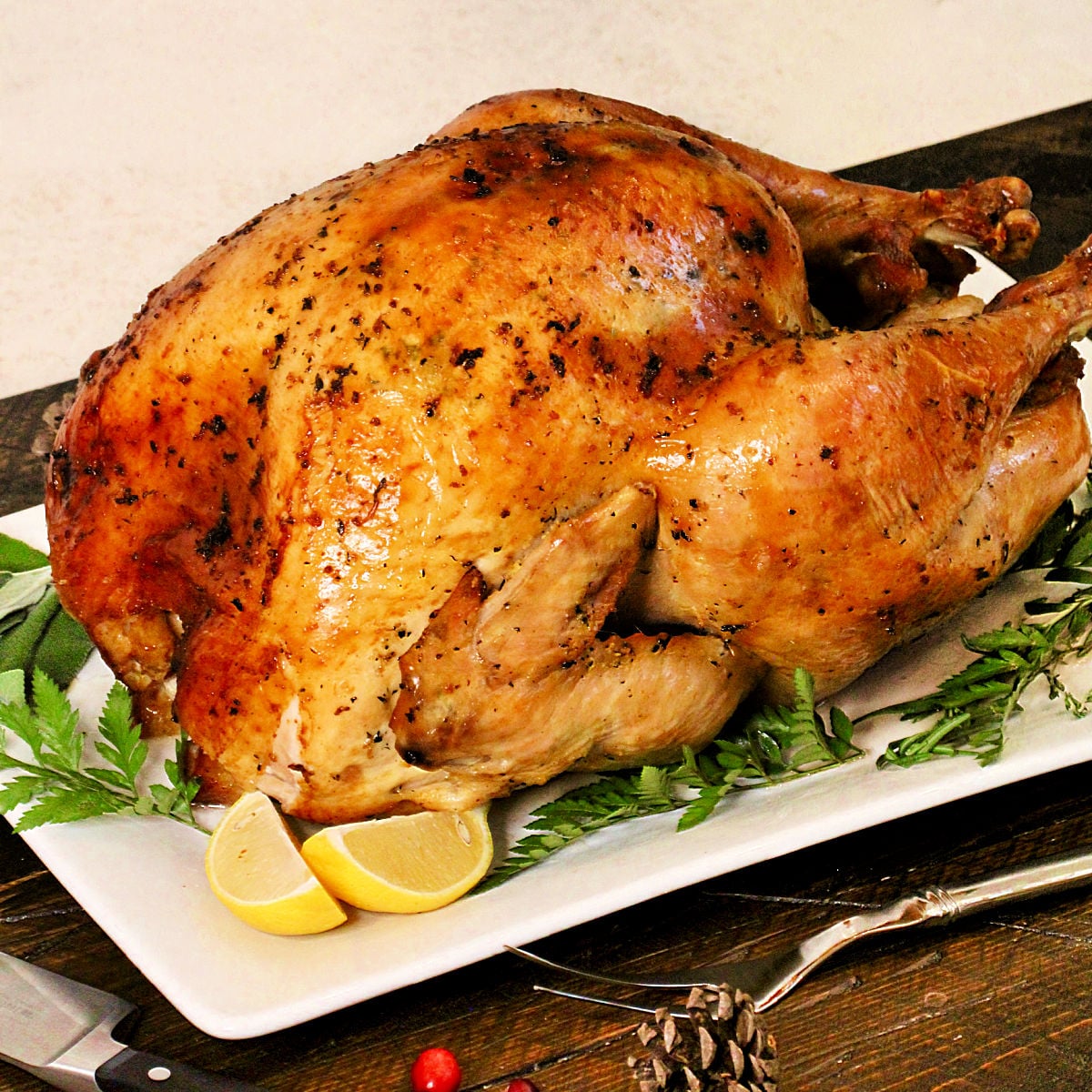
Perfect Roast Turkey
Whether you're a first-timer or a seasoned pro, this easy Roast Turkey recipe guarantees a juicy and flavorful bird that will steal the show at your Thanksgiving or Christmas dinner.
Servings: 18
Calories: 367kcal
Equipment
Ingredients
Roast Turkey
- 1 turkey, approximately 18 pounds
- 1 medium yellow onion, halved
- 1 carrot, cut into large pieces
- 2 stalks celery
- 1 bay leaf
- 1 lemon, halved
- few sprigs thyme
- few sprigs rosemary
- few sprigs sage
Herb Butter
- 1 stick unsalted butter, softened
- 4 cloves garlic, minced
- 1 tablespoon chopped thyme
- 1 tablespoon chopped rosemary
- ½ tablespoon chopped sage
- ½ teaspoon kosher salt (optional)
For The Roasting Pan
- 2 cups reduced sodium turkey or chicken broth
- 1 cup dry white wine (like Sauvignon Blanc or Pinot Grigio)
- onion, carrots, celery, peeled and roughly cut into chunks
Dry Brine (optional)
- 3 tablespoons kosher salt
- 1 teaspoon black pepper
- 1 tablespoon packed light brown sugar
Turkey Gravy (optional):
- 3 tablespoons fat from pan drippings or butter
- 3 tablespoons flour
- 3 cups drippings and/or chicken stock
- Salt and pepper
- ¼ cup half and half
Instructions
- Unwrap the turkey and remove the giblets. Pat it dry with paper towels.
- Place the turkey on a sheet pan. If you are going to brine the turkey, mix the salt, pepper, and brown sugar together in a small bowl. Rub the dry brine all over the turkey and inside the cavity. Place the turkey in the refrigerator, uncovered, and refrigerate for 24 hours. This will help the skin dry out so that it crisps up nicely as it cooks.
- On the day that you're ready to cook, preheat the oven to 325°F. Stuff the cavity of the turkey with the onion, carrot, celery, bay leaf, lemon, thyme, rosemary, and sage. Tie the legs of the turkey with kitchen twine. Tuck the wings underneath.
- To make the herb butter, mix the softened butter with the garlic, thyme, rosemary, sage, and salt (skip the salt if you have brined the turkey). Loosen the skin of the turkey gently by sliding your fingers underneath. Rub about ⅓ of the herb butter between the skin and the breast.
- Rub the remaining herb butter all over the entire outside of the turkey.
- Put the turkey on a roasting rack and place it in a roasting pan. Scatter some chunks of onion, celery, and carrots around in the pan. Pour the turkey broth and white wine into the bottom of the pan.
- Cover the turkey loosely with aluminum foil to prevent over-browning and transfer the roasting pan to the oven. Roast at 325°F for about 3 ½ hours. Then, take the foil off and increase temperature to 400°F. Roast another ½ hour until done. Insert an instant read thermometer into the thickest part of the thigh and breast without touching the bone. Remove turkey from oven when it reaches an internal temperature of 160°F. Let the turkey rest for at least 30 minutes before carving. As the turkey rests, the temperature will continue to rise to 165°F.
To Make Turkey Gravy:
- While the turkey is resting, you can make a quick turkey gravy, if desired. To do this, remove the vegetables from the bottom of the roasting pan and strain the pan drippings through a strainer to remove any large solids. Pour the strained drippings into a gravy separator. If you don’t have one, pour the drippings into a bowl. The fat will rise to the top after a few minutes. Spoon out 3 tablespoons of the fat and add it to a large saucepan (or you can make the gravy in the roasting pan on the stove). Discard the remaining fat. If you don’t have quite 3 tablespoons of fat, you can use some butter. Pour the drippings into a large measuring cup and add enough turkey/chicken stock to make 3 cups.
- Heat the fat in the saucepan or roasting pan on the stove over medium heat and add the flour. Whisk together for 1-2 minutes. Add the drippings and whisk continuously until smooth. Simmer a few minutes until gravy thickens. Season with salt and pepper to taste. Add half and half, if desired, for a richer gravy.
- Pour gravy into a gravy boat and serve alongside the carved turkey.
Notes
- Make sure you let the turkey rest for at least 30 minutes before carving to let the juices redistribute. Otherwise, all the juices will run all over your board instead!
- I like to roast my turkey at a low temperature, covered loosely with foil to prevent over-browning. Then at the end, I remove the foil shield and turn the oven temperature up to get it nicely browned. Keep a close eye on it during the last 30 minutes. You can always put the foil back on or lower the temperature if it's getting too dark.
Nutrition
Serving: 1 serving (turkey only) | Calories: 367kcal | Carbohydrates: 3g | Protein: 63g | Fat: 11g | Saturated Fat: 5g | Polyunsaturated Fat: 1g | Monounsaturated Fat: 3g | Trans Fat: 0.2g | Cholesterol: 200mg | Sodium: 1500mg | Potassium: 710mg | Fiber: 1g | Sugar: 2g | Vitamin A: 1403IU | Vitamin C: 4mg | Calcium: 44mg | Iron: 3mg
